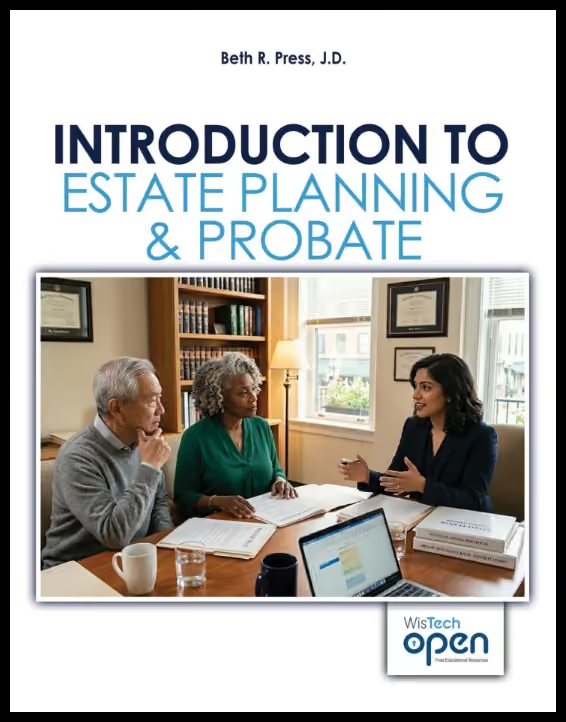
.svg)
129 students | 2 high school students | $14,964 student savings
Course Competency 1: Classify property as real property, intangible personal property, tangible personal property, probate property and non-probate property
Learning Objectives:
- Differentiate between real property, tangible personal property and intangible personal property
- Differentiate between probate property and non-probate property
Course Competency 2: Classify property ownership as sole or multiple party ownership and explain how different types of property ownership affect issues in estate planning
Learning Objectives:
- Differentiate between tenancy in severalty, tenancy in common, joint tenancy, tenancy by the entireties, marital property and survivorship marital property
- Explain the elements and requirements of each type of property ownership
- Explain how each type of property ownership impacts a client's estate plan
Course Competency 3: Differentiate between testate and intestate succession of various classifications of property
Learning Objectives:
- Explore the rules of succession relating to intestate and testate estates
- Classify property as probate or non-probate and describe the rules of succession relating to each type of property
- Classify property as real or personal and describe the rules of succession relating to each type of property
Course Competency 4: Use effective checklists for gathering information relevant to estate planning
Learning Objectives:
- Evaluate different types of checklists for obtaining information relevant to estate planning
- Identify proper questions and professional behavior for a client interview
Course Competency 5: Draft a valid will
Learning Objectives:
- Explain common issues arising in drafting wills
- Evaluate standard will forms and "boilerplate" language
- Draft a simple will using information obtained in a mock client interview
Course Competency 6: Explain how wills are modified and revoked
Learning Objectives:
- Investigate Wisconsin's statutory requirements for the execution of valid wills
- Explain the various methods for modifying wills
- Describe the manner in which wills are revoked
- Identify grounds to contest a will, and who is allowed to contest a will
Course Competency 7: Summarize probate in Wisconsin
Learning Objectives:
- Investigate the Wisconsin probate court system
- Identify persons participating in a Wisconsin probate and their duties/powers
- Explain the concepts of subject-matter jurisdiction, personal jurisdiction and venue
Course Competency 8: Draft informal probate and estate administration forms used in Wisconsin
Learning Objectives:
- Identify the circumstances allowing for informal probate procedures in Wisconsin
- Recognize forms used in informal probate procedures in Wisconsin
- Complete the forms used in informal probate procedures in Wisconsin
Course Competency 9: Identify different types of trusts and their elements
Learning Objectives:
- Explain the required elements of trusts in general
- Differentiate between revocable and irrevocable trusts
- Differentiate between inter vivos and testamentary trusts
- Differentiate between active and passive trusts
Course Competency 10: Explore documents used in a comprehensive estate plan
Learning Objectives:
- Identify fact scenarios calling for tax-planning in an estate plan
- Describe methods of using trusts as tax-planning tools
- Investigate powers of attorney, anatomical gifts and health care proxies as "lifetime" estate planning documents
Course Competency 11: Describe the function of a paralegal in an estate planning and estate administration law practice
Learning Objectives:
- Explain the paralegal’s role in the estate planning process
- Explain the paralegal’s role in the estate administration process
- Explain the paralegal’s role in drafting estate planning documents
- Explain the paralegal’s role in drafting estate administration forms
Course Competency 12: Describe ethical issues commonly arising in estate planning and estate administration
Learning Objectives:
- Identify ethical issues commonly arising in estate planning and estate administration
- Describe methods of avoiding conflicts of interest in estate planning and estate administration
- Explore professional and ethical standards applicable to paralegals
Creative Commons License
This textbook is licensed under a Creative Commons Attribution-NonCommercial-ShareAlike 4.0 International (CC BY-NC-SA 4.0) license unless otherwise indicated. This means that you are free to:
- SHARE – copy and redistribute the material in any medium or format
- ADAPT – remix, transform, and build upon the material
Under the following terms:
- Attribution – You must give appropriate credit, provide a link to the license, and indicate if changes were made. You may do so in any reasonable manner, but not in any way that suggests the licensor endorses you or your use.
- NonCommercial – You may not use the material for commercial purposes.
- ShareAlike – If you remix, transform, or build upon the material, you must distribute your contributions under the same license (CC BY-NC-SA 4.0).
The licensor cannot revoke these freedoms as long as you follow the license terms.
WisTech Fusion
WisTech Fusion is a new tool that’s designed to help with one of the biggest challenges in OER—creating all the “extras” that usually come with a traditional textbook.
With Fusion, you can generate things like:
- Quizzes and assessments
- Slide decks
- Study guides
- Worksheets
- Case studies
Instead of building these from the ground up, Fusion gives you a starting point that you can edit and adapt for your course.
· Explore WisTech Fusion
To help keep print textbook costs low for our students, please consider using the electronic version, or purchasing a personal print copy, rather than requesting a publisher/desktop version from our printing partner. Orders can be placed through Kendall Hunt: